skip to main |
skip to sidebar

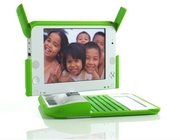
OLPC spinoff Sugar Labs announced today that they are releasing "Sugar on a Stick", a version of the wonderful Sugar learning applications from the One Laptop Per Child that runs from a USB stick (based on Fedora Linux LiveUSB technology).
This will allow children to have access to their software environment from most computers at home, at school, or (maybe) in libraries simply by booting from the USB stick. Since the stick bypasses the machines' own hard disk, it can be used with computers normally running MS Windows, Linux or the Macintosh OS. It can even be used with computers without hard disks.
Not only is this a great software package for kids, but it points to a low-maintenance-cost public computing model that could open up new possibilities for libraries.
Powered by ScribeFire.
 Hewlett-Packard has announced its entry in the growing student laptop market-- the Mini-Note.
A direct competitor to the Eee PC from Assus, and maybe student laptops like the OLPC XO or the Intel Classmate, the Mini-Note will be offered with either various flavors of Microsoft Windows Vista or SUSE Linux Enterprise Desktop, in prices ranging from US$499 to $849. Base models will come with 4 GB flash drives, pricier models will get 120-160 GB hard drives. All will come with 8.9 inch displays, wireless access, web cams, and VIA C7 processors.
It's great to see this market heating up-- if the OLPC folks started the world thinking about this market, the success of the Eee PC has shown there's money to be made here. The entry of a big player like HP is good news-- getting more of these into the hands of more students will take us one step closer to a transition to e-textbooks.
 By now you have probably heard of the One Laptop Per Child program's Give 1 Get 1 program which allows (North American) consumers to purchase an XO laptop for twice the price, and donating a second XO to a child in a developing country. Originally planned to run for just two weeks, it's now been extended to the end of the year.
One of the reasons given for the extension is to allow organized fund raising campaigns to get involved. I know I have heard several suggestions that U.S. schools raise money to purchase XOs for their own use while helping a school overseas.
It's on my short list for Christmas!

The AP is running a good summary of the OLPC project today, along with news that the XOs will go into production by July.
"Several million are expected to reach Brazil, Argentina, Uruguay, Nigeria, Libya, Pakistan, Thailand and the Palestinian territory."
An exciting way to start the year-- I wonder if people felt this way when the Model T was going into production!
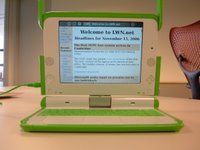 Christopher Blizzard reports that the OLPC people have received the first hand-built X0-1 "Test build" device destined for "destructive testing" over the next few months.
There are interesting pictures posted on the OLPC wiki.
The pictures show the display in both black and white and color mode, the touchpads (including the one intended for use with a stylus), and one of the keyboard layouts.
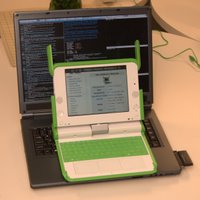 Most interesting to me, was this photo showing the comparative size of the device when placed on a "normal" laptop. It is clearly scaled for little hands.
It is so exciting to see this project hit important milestones with such apparent success.
 Technology Review has a good article on the OPLC X0-1 (yes, that seems to be the official new name), which compares the project to Andrew Carnegie's project to build libraries across the United States and Great Britain from a hundred years ago.
I'm glad more people are seeing this connection-- the OLPC project is no more about computers than Carnegie's project was about architecture. It's all about making information available to all, or nearly all. Remember that if the OLPC really does meet its goals of putting tens of millions of these devices in the hands of students around the world, each one will be an e-book reader. This will revolutionize publishing, and not only in the developing world.
 Popular Science magazine has selected the OLPC's 2B1 (or maybe it's now called the XO) as a "Grand Award" winner in it's Best of What's New 2006 article.
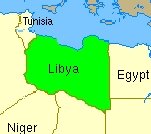
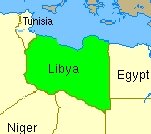 Well, just as we were worrying that the coup in Thailand would slow down the OLPC project's drive to reach a critical mass of orders, Libya signs on with an order for 1.2 million units.
I'm reminded of the comment by Apollo 13 astronaut (or at least Tom Hanks playing Jim Lowell) that, "You never know what events are going to transpire to get you home."
Christopher Blizzard has posted a newsy update to his blog detailing progress on developing the 2B1 One Laptop Per Child device.
You can read all about it here.
They seem to be making rapid progress, although with pre-production models due for testing in the wild (i.e. real children!) in just a few months, they had better!
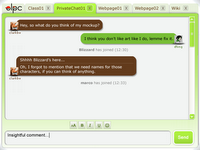 Sugar is the new interface for the OLPC laptops. Rather than simply using Gnome or some established Linux front end, the folks at the OLPC decided to desgn their own interface incorporating tools to assit if the educational and social-computing goals of the project.
For example, Mesh View is a way of displaying the active laptops in the mesh network-- the peer to peer wireless network the units generate.
Friends View allows users to add and remove friends and invite them to participate in activities with a few clicks.
Other collaborative software will include the widespread use of Wikis.
If only the software we adults use permitted that kind of easy collaboration!
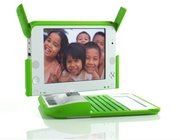 The One Laptop Per Child device has its production name: the 2B1
Lesser known in the West perhaps than its laptop features is the fact that the screen is designed to pivot around so it can be used as an ebook reader. The potential to replace printed textbooks with cheaper e-textbooks is an important consideration in funding the purchase of these machines. See the discussion here.
If successful, the 2B1 will clearly change schools, but I think that it may also change libraries. E-textbooks have always seemed to me to be a perfect "killer app" for electronic publishing-- textbooks are read for facts, not narrative, and are a required purchase, not a choice. Further, they are required by institutions that would also be in a position to dictate the model of hardware reader. The 2B1 could become the standard, low-cost reader the market has needed all along. Once people own a standard reader, they might be willing to read more in electronic form.
Which leads to libraries. Here we are, slowly (perhaps too slowly) and steadily building our ebook collections, waiting for patrons to catch on. For the first time in years, I think we can see a plausible way that they might do just that.